It’s amazing how boringly pedestrian many of the early Edison films were, but that did not stop Americans from pumping Kinetoscopes full of quarters, a sizable investment in entertainment at the time.
Most of these 20 to 30 second films (a quarter bought you five at a time) captured moments the audience was intimately familiar with: dancing, kissing, and running. There was no story. It wasn’t necessary. There was just the revolutionary new pleasure of watching moving photographs of other human beings doing things, and that same pleasure, which only novelty can evoke, runs through many of Hollywood’s innovations. After the novelty of viewing daily activities wore off, narrative was introduced, and later, editing heightened the viewer’s involvement in that narrative. Then stars, sound, double features, color, Technicolor, Cinerama, drive-ins, 3-D, exploitation, gimmicks (e.g., Hitchcock’s refusal to let anyone into showings of Psycho once the movie started), nudity, graphic sex, extreme violence, gore, the summer blockbuster, etc.
Novelty lies at the core of American film. The first wave of movie moguls had no interest in making art. They were, predominantly, first and second generation Eastern European immigrants trying to survive in a system that blocked them from the traditional paths of upward mobility due to their “foreignness” (read Jewishness). Louis B. Mayer sold junk before becoming the second ‘M’ in what became MGM. Junk or movies, same difference. Product is product, and product must always move.
The pleasure of novelty is intimately linked to the communal experience of watching a movie in a theater with others. Pleasure experienced alone is often sapped of its vitality, its humanity. When William Castle placed joy buzzers under some seats to drum up business for his 1959 cheapie exploitation film “The Tingler,” he was mining that rich vein. Would you get the buzzer or your neighbor? When an audience member yelped in surprise, I imagine a shared moment of laughter driven by the momentary relief of knowing it wasn’t you…this time. For 82 minutes, every audience member was drawn into an experience they shared in the dark together.
Today, sadly, novelty has largely been lost, and with it, the pleasure of the movies has suffered. My own interest in seeing large studio movies in theaters withered post-COVID. With the frictionless assembly line of sequels, remakes, and IP extravaganzas, Hollywood has turned its back on new ideas.
This week, though, I was reintroduced to this holy dyad of novelty and pleasure via AMC’s Screen Unseen series, which shows unreleased movies without announcing the title beforehand. I was intrigued, and as a result of attending, I saw a movie I otherwise would not have watched: “Normal.”
“Normal” continues the trend of Bob Odenkirk as an unassuming badass that started with his 2021 film, “Nobody.” While this might be one of the strangest late-career celebrity renaissances in recent memory, Odenkirk’s undeniably affable charm brings something new to the action genre. At its core, “Normal” is a Western. Odenkirk plays a “sheriff” (as opposed to a cop or officer). Much is made of the throwback star that he wears instead of a badge, and the plot mines similar territory to several classic cowboy flicks. Director Ben Wheatley elevates the material with his pitch-black sense of humor, particularly in the scenes of Rube Goldberg-style gory mayhem.
While the movie was perfectly enjoyable, the novelty was what made the night for me. Seeing a movie before anyone else, PLUS not knowing the title, added a frisson that became impossible to separate from the movie itself. I felt like I shared a conspiratorial secret with the audience. The woman in the next seat offered me some of her fresh strawberries, reinforcing the sense that we were all in this together. The experience was better because of this new communal thing we were doing.
So, if badass Bob Odenkirk is your bag, go see “Normal,” or wait until it’s streaming. The movie is not the thing; the experience is. Screen Unseen brings back a little of what going to the movies used to feel like, not as desiccated nostalgia, but as living pleasure.
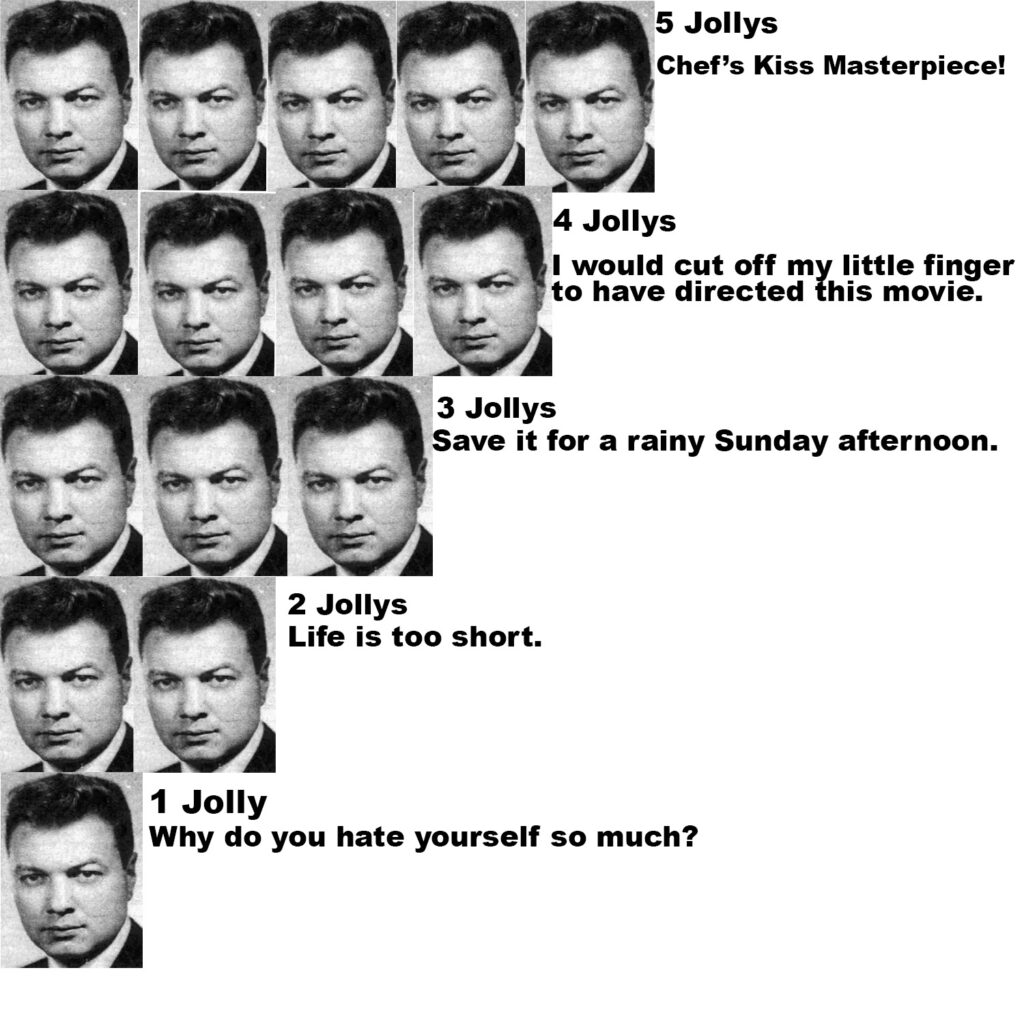
Three Jollys for the movie.
Five Jollys for the experience.