Radio Free Brooklyn caught up with Liz Cooper about the release of her recent album “New Day,” highlighting the highs and lows of her tenure in New York City, including teaching herself to play piano and finding a new sound after over 10 years in the industry.
No conversation about the depth and range of an artist is complete without mentioning Liz Cooper. Performing at Night Club 101 in Manhattan’s Alphabet City, Cooper ran the gamut from hard rock to tender tunes, demonstrating not only her musical talent but also her ability to adapt a sound that matches her mood at various points in her life. This exploration is a cornerstone of Cooper’s new album, “New Day”, released on February 20th. The record reflects on Cooper’s five-and-a-half-year stint in New York City and the challenges that came with it, including the beginning and end of her first queer relationship, a global pandemic, and her work to accept herself for who she is.
In an interview with Radio Free Brooklyn (RFB), Cooper said each of her three albums—“Window Flowers” (2018), “Hot Sass” (2021), and her latest, “New Day” —are separate sonic journeys, representing the growth Cooper has experienced in her 10+ years as an artist. On “New Day,” Cooper points to “IDFK” as the most accurate representation of herself in the current moment. “It’s tender, which grabs onto older albums. There’s more of a songwriter crooning to it.”
If you’re a fan of ethereal indie music with a hint of reminiscence on past relationships, then “IDFK” is the song for you. Rather than an acronym of “I don’t fucking know,” in this case, the chorus sings “I don’t forget know that I’m thinking of you.” In an Instagram post from October 28, 2025, Cooper said, “IDFK is about the connection of the past in the present, the connection between who the main character in the song showed me I am and the person I am becoming, the feeling of a memory and intimacy across time and space. This is a love song to a friend and to myself.” Nostalgia seems to be a major theme of this track, with lyrics drawing listeners to consider their own relationships, both with themselves and with past partners, and how they’ve evolved.
Do you think about me?
I think I’m better now, I hope you’re better now
I think about you
I think I’m better now, I hope you’re better now
I think I miss you
But it’s better now, I know it’s better now
To the strange within us, cheers
The echoes of earlier albums in “IDFK” are hard to miss. When I first discovered her in 2018 on “Wildflowers,” she was part of Liz Cooper and the Stampede. With Cooper as the central voice, the indie folk-rock trio focused on soft sounds, infused with rock elements like guitar solos and heavy percussion. Cooper’s voice stands out in a genre saturated with female lead vocalists. Her sound is unique in its naturally raspy, campfire-musician quality, making it feel like she’s singing just for you. The personal touch permeates her previous records and organically comes into play on “New Day.” In particular, “Lights” from “Wildflowers” seems to be a forbear of “IDFK.” Cooper said there’s a hopefulness to “Lights,” and to others from the 2018 record—a naive nature that doesn’t necessarily reflect her current state of being.
“I’m proud of all those songs and that period of time. But I landed there as a teenager, and my tastes changed naturally when my interests expanded,” she explained.
Part of Cooper’s intention with “New Day” was to distance herself from her previous work, acknowledging that they’re a part of her story while simultaneously navigating the music industry in a new way. She told RFB that this record was her most challenging because of the struggle that went into creating it, both in its production and in the experiences that inspired the songs.
Cooper dismantled her traditional techniques for making music on this record, uncovering new approaches to song development. Rather than working with a full band, Cooper recorded demos alone in her New York City apartment during the height of the pandemic. She assumed production duties for the first time in her career, leading her to experiment with her sound. With her co-producer, Dam Molad, she generated unique guitar elements, forging into uncharted territory. “Instead of writing my guitar parts note by note, I was experimenting on the spot,” she says. “It opened my mind up – and it felt really good.” Cooper also taught herself to play piano during lockdown, unearthing a new creative channel for her to explore. “It felt like someone I could lean on – like the piano was my voice when I couldn’t talk or sing,” says Cooper.
Cooper told me of her growing pains in recent years. Before her move to New York City in February of 2020, her original home base was Nashville, where she’d been since she was 19 years old. Nashville was just a launching pad, a temporary stop as Liz Cooper and the Stampede toured intensively, playing festivals coast to coast, including a debut performance at Austin City Limits Music Festival in 2017, and opening for acts like Lord Huron and Houndmouth. She expected to continue touring as a musician after her move to NYC, but the pandemic quickly shuttered venues indefinitely. Once she stopped her nationwide escapade, she was forced to confront the things she had been wrestling with. Namely, her identity as a queer person.
“I struggled so much while writing this record,” Cooper says. “I felt like I wasn’t allowed to come out – I was dealing with a lot of internalized homophobia.”
While in New York City, she experienced her first queer relationship and the intense feelings that came with it. The end of her relationship also came and went during her half-decade in the city, intensifying her feelings and driving her to create music that represented her experience. Stepping into her queerness, Cooper experienced heartache in a way she hadn’t before, and that personal journey shaped her music on “New Day.”
“I had to stop and listen to myself, and New York pushed me to do that. ” she explained.
At NightClub 101, in the same city that inspired her record, Cooper played songs from both “Hot Sass” and “New Day.” The track that stood out to me was the title track from “Hot Sass”, the song itself wild and loud, juxtaposing her softer voice with hard rock. On stage, her energy stretched through the crowd, surrounding us, then drawing us closer to the heart of the song. Her stage presence confirmed that Cooper has evolved since New York, and despite the challenges, she’s taken the best of what she learned and applied it to her craft.
“Celebrating my queerness and understanding who I am has been a long process. Every day is a new day of coming out to myself and to everyone around me.” She said, “I’m very proud to be making music that feels honest to me and my experience.”
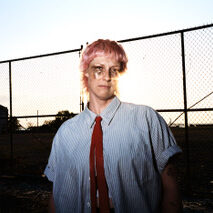
PHOTO: Michael Heinz