A public artwork of 1,516 social media posts visualizing President Trump’s state of mind. Unveiling Friday, Oct. 30 at noon at 12 Grattan Street, Bushwick, Brooklyn.
BROOKLYN, NEW YORK — Independent community radio station Radio Free Brooklyn (RFB) will present the Wall of Crazy, a new large-scale public artwork by Brooklyn artist Phil Buehler, opening Friday, Oct. 30, just in time for the Nov. 3 midterm elections.
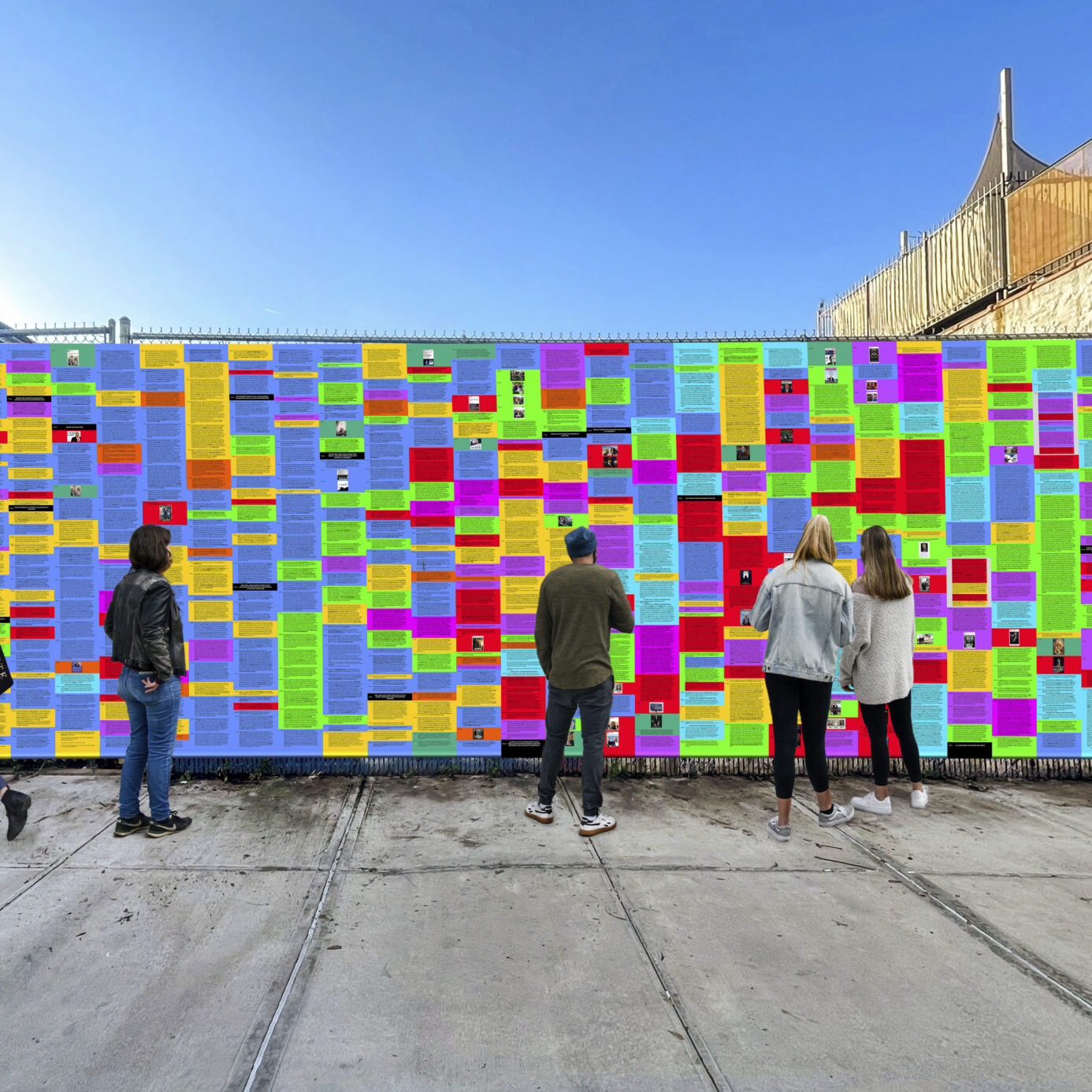
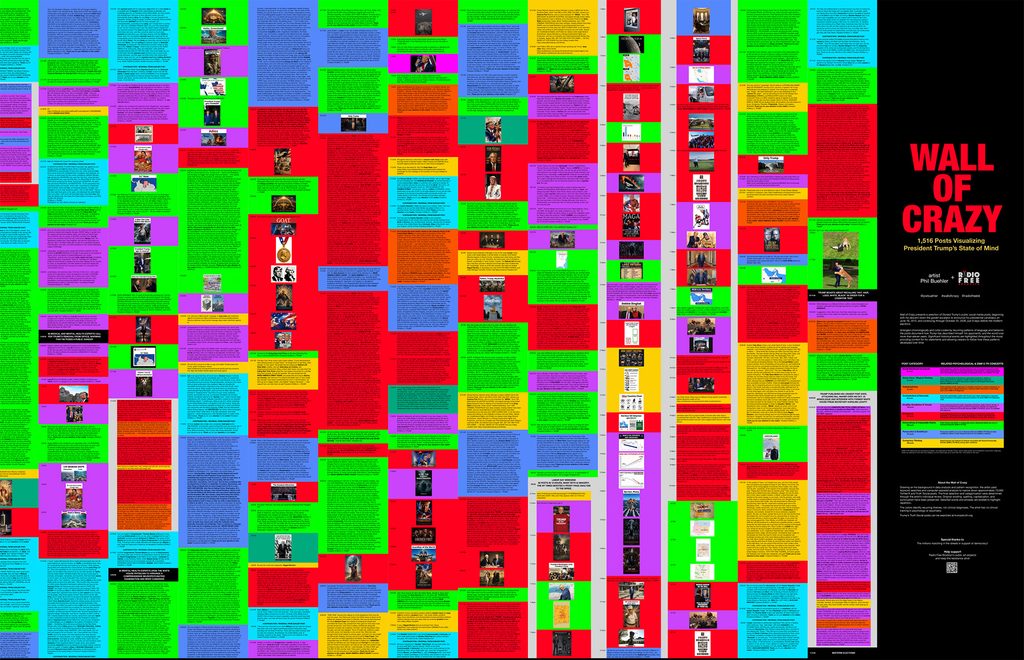
The 50-foot-long, 10-foot-tall outdoor mural brings together 1,516 of Donald Trump’s social media posts. These were selected from over 70,000 posts he made on Twitter/X and Truth Social between June 16, 2015, when he announced his presidential candidacy, and Oct. 25, 2026.
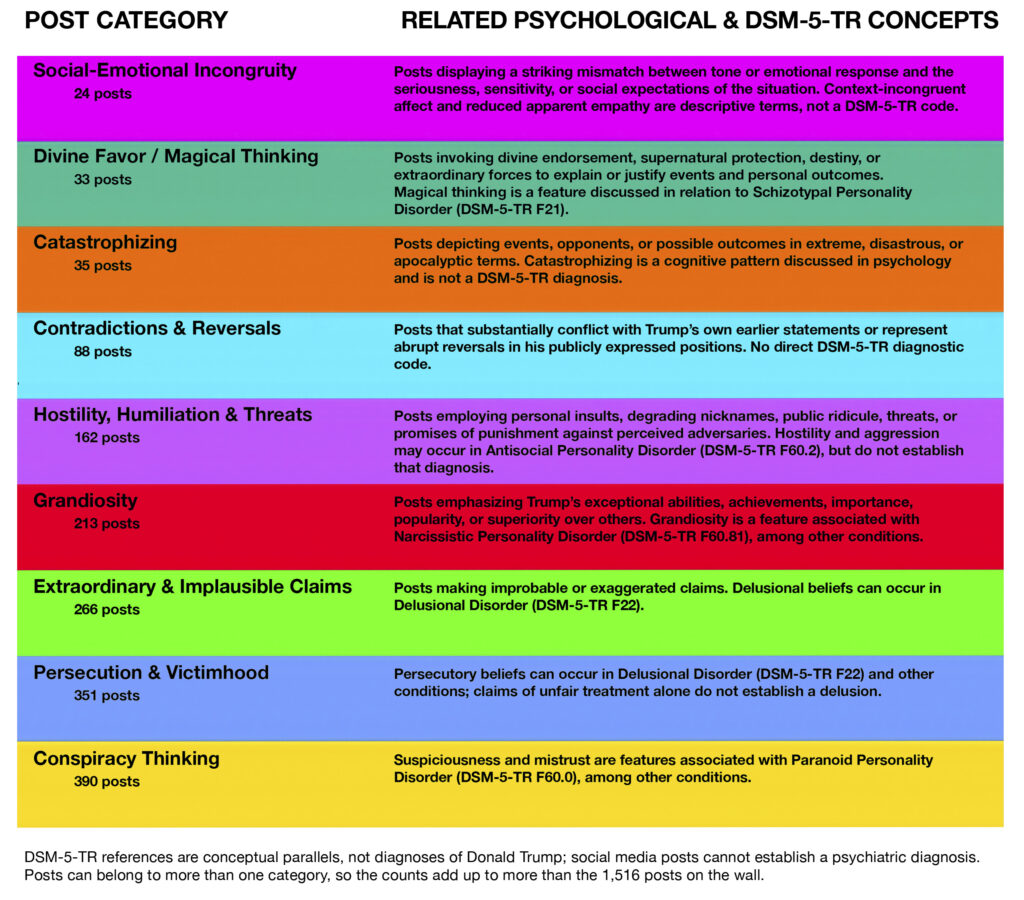
Arranged chronologically and color-coded by recurring patterns of language and behavior, the posts include boasts about his intelligence and accomplishments, personal attacks, conspiracy theories, contradictions and reversals, and other unusual statements. Significant historical dates appear throughout the mural, providing context for Trump’s statements as events unfolded.
Some of Trump’s posts generated headlines and controversy; others might seem unremarkable on their own. People may disagree about the significance of any individual post. But together on a 50-foot wall, they reveal recurring themes, contradictions and patterns that might otherwise go unnoticed.
The mural’s color-coded categories draw on psychological terminology, including concepts referenced in the DSM-5-TR, to identify recurring patterns in Trump’s public statements. These references are intended as points of comparison, not clinical findings or psychiatric diagnoses. The Wall of Crazy presents Trump’s own words, allowing visitors to examine the patterns and draw their own conclusions.
“My background is in data analytics and pattern recognition, and when you look at more than 1,500 of Trump’s posts together, you start to see patterns that aren’t so obvious when you read them one at a time,” said Buehler. “And some of those patterns — the grandiosity, the persecution, the contradictions — are hard to look away from. I’m not a psychologist or psychiatrist. I’m an artist. But I find a lot of what he says disturbing, and I’m worried about what’s happening to our country — and what might happen next.”
Why now?
Why now? The mural opens less than a week before the Nov. 3 midterm elections, which will determine control of Congress for the final two years of Trump’s presidency. His social media activity has become a recurring subject of news coverage, with individual posts generating headlines, controversy and debate. On Sept. 9, for example, The New York Times documented 60 posts published over 10 hours, many featuring images and videos.
While news coverage generally focuses on individual statements or posting sprees, the Wall of Crazy brings together more than a decade of posts in one place. Viewed chronologically, they provide a broader perspective on recurring themes, contradictions and changes in Trump’s public statements over time.
The Wall of Crazy continues Buehler’s collaborations with Radio Free Brooklyn, including Wall of Lies (2020), documenting more than 20,000 false or misleading Trump claims; Wall of Liars and Deniers (2022), featuring 381 Republican election-denying candidates; Wall of Shame (2025), documenting 1,575 Jan. 6 defendants pardoned by Trump; and Wall of Tears (2026), memorializing 18,457 children documented killed in Gaza.
“The Wall of Crazy shows how Buehler and Radio Free Brooklyn use public art to spotlight our political climate. Calling out the inflammatory, incoherent, divisive and obscene rhetoric under this administration is critical to democracy,” said Orie Givens, President of the Radio Free Brooklyn Board. “Like earlier walls, it captures our political culture and urges action before Election Day: voters can change the country’s direction. And, it shows why we must support free media — especially independent outlets — that expose this administration’s actions and impact nationwide.”
Like Buehler’s previous installations, the Wall of Crazy is designed to be experienced at different distances: from afar as a large-scale visual statement, and up close through its individual details. Visitors can follow recurring themes through the color coding and consider Trump’s statements alongside significant historical events.
How the posts were selected
Drawing on his background in data analytics and pattern recognition, Buehler used keyword searches and computer-assisted thematic analysis to identify unusual, revealing or frequently repeated statements. He grouped the posts by theme and reviewed them individually, making the final selections based on his judgment as an artist.
Although the mural opens just before the midterm elections, the questions it raises about Trump’s public statements extend beyond Election Day. It will remain on display through January 3, 2027, when the newly elected Congress convenes.
For media inquiries, contact Orie Givens or Phil Buehler.
Radio Free Brooklyn depends on our community to support public art projects like Wall of Crazy, and to power our 24/7 all-volunteer nonprofit network. If you believe in public art and independent radio, please give to Radio Free Brooklyn.


